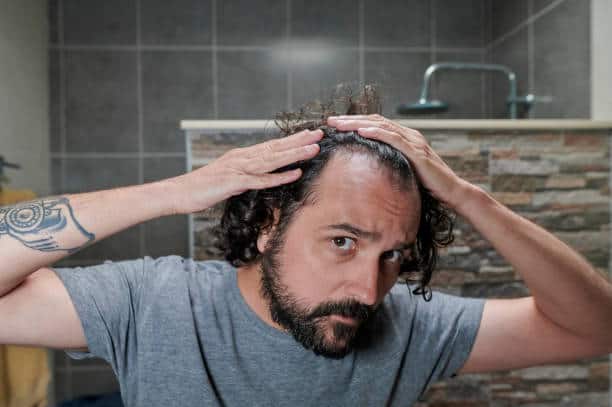
GLP-1 hair loss is real, and it is also almost always temporary. The shedding that turns up two to four months into semaglutide or tirzepatide is a reaction to how fast the weight is coming off, not a sign the drug is dismantling your follicles. That distinction matters, because it tells you what to fix and what to simply wait out.
We see this often at the clinic. A man drops 12 kilos in four months, feels better than he has in a decade, then starts finding hair in the shower drain. The instinct is to blame the injection. The real story is more interesting.
What GLP-1 hair loss actually is
Scalp hair does not grow continuously. At any given moment roughly 85 to 90 percent of your follicles sit in the growth phase, called anagen, while the rest are resting or shedding. A physiological stress — surgery, a high fever, a crash diet, a sharp calorie deficit — can shove an abnormally large share of follicles out of anagen all at once. They do not fall out straight away. They fall out two to four months later, together, which is why the timing feels so disconnected from the cause. Dermatologists call this telogen effluvium, and it explains nearly every case of GLP-1 hair loss.
The pattern itself is a useful clue. Telogen effluvium thins hair diffusely across the whole scalp: the part widens, the hair feels lighter in your hand, and you shed perhaps 150 to 300 hairs a day instead of the usual 50 to 100. It does not carve out a receding hairline or a bare patch at the crown. That is a different problem, and we will come back to it.
Why rapid weight loss shocks the hair cycle
Hair is expensive and, biologically speaking, optional. Follicles contain some of the fastest-dividing cells in the body, so when energy and protein run short they are among the first things your physiology deprioritises. GLP-1 medications such as semaglutide and tirzepatide work by cutting appetite hard — many patients eat 30 to 40 percent fewer calories without consciously trying. That is the entire point of the drug. It also happens to be exactly the kind of energy shortfall that triggers a shed. GLP-1 hair loss, in other words, is mostly a weight-loss side effect wearing a drug’s name.
None of this is unique to these medications. The same shedding shows up after bariatric surgery, after very low-calorie diets, after a serious infection. The drug is the accelerator; the deficit is the cause. That is good news, because a deficit is something you can manage.
How common is GLP-1 hair loss?
Less common than social media would have you believe. In the STEP 1 trial of semaglutide, alopecia was reported by about 3 percent of participants on the drug versus roughly 1 percent on placebo — a genuine signal, but a small one. Tirzepatide trials have landed in a similar range, with slightly higher rates at the top doses and in women. Most men on a GLP-1 never notice any change in their hair at all.
Rates reported in online forums run much higher, partly because the people who experience a side effect are the ones who post about it. If you are in the group that does shed, the trial numbers will not comfort you much. They do argue against panic.
The nutrient gap nobody plans for
This is where GLP-1 hair loss stops being bad luck and starts being preventable. Eating 1,300 calories a day when your appetite has vanished makes it very hard to hit the 1.2 to 1.6 grams of protein per kilogram of body weight that muscle, skin and hair all compete for. A handful of micronutrients matter too:
- Ferritin (stored iron) — levels below roughly 30 ng/mL are repeatedly linked to diffuse shedding, and men who quietly cut red meat while on a GLP-1 can fall fast.
- Zinc — required for follicle protein synthesis, and intake drops with total food volume.
- Vitamin B12 and vitamin D — both commonly low in men eating far less than they used to. See our guide to B12 dosage for men.
- Thyroid function — worth checking, because an underactive thyroid produces an identical-looking shed.
A basic panel settles most of these questions in one visit. Our blood test service covers ferritin, thyroid and vitamin status alongside the usual metabolic markers.
How to protect your hair while on a GLP-1
Five things make a measurable difference, and none of them require stopping treatment:
- Titrate slowly. Jumping doses to chase faster results is the single biggest driver of shedding. Aim for 0.5 to 1 percent of body weight per week, not more.
- Defend your protein. Small appetite, high-protein food. Eggs, fish, chicken, Greek yoghurt or a shake — whatever survives the nausea.
- Lift something heavy twice a week. Resistance training protects lean mass, and the same habits that prevent muscle loss on GLP-1 medications tend to protect hair.
- Test rather than guess. Ferritin, B12, vitamin D, thyroid, and for men, testosterone.
- Be patient for six to nine months. Left alone, most GLP-1 hair loss resolves without any intervention at all. Regrowth begins once the shock passes, and new hairs are short and wiry at first — easy to mistake for breakage.
Stopping the medication abruptly is rarely the answer, and it brings its own set of problems: read what usually happens when men stop taking Ozempic before making that call. If you are still choosing between agents, our comparison of Ozempic and Mounjaro covers how the side-effect profiles differ.
When the GLP-1 is not the culprit
Sometimes weight loss simply unmasks what was already happening. Male pattern baldness follows a distinct map — temples first, then the crown — and it progresses over years rather than arriving in a single dramatic wave. Mayo Clinic describes the classic presentation clearly. If your hairline has been quietly retreating since your early thirties, a GLP-1 did not start that.
The treatments differ accordingly. Telogen effluvium resolves on its own once the trigger is removed. Androgenetic loss needs ongoing therapy, and it is worth knowing how minoxidil and finasteride differ and whether minoxidil actually works for men. Plenty of men on a GLP-1 have both processes running at once, which is why an examination beats guesswork.
If your hair is thinning while you are losing weight, bring it up rather than quietly tolerating it. Boost Health Clinic runs doctor-supervised weight loss programmes and hair loss treatment under one roof, so the two can be sorted out together instead of separately.
GLP-1 weight-loss treatment near you: Mounjaro, Ozempic and Wegovy in Bali · Mounjaro and GLP-1 medications in Jakarta
This article is general information and not medical advice. All treatments mentioned require assessment by a qualified doctor.