
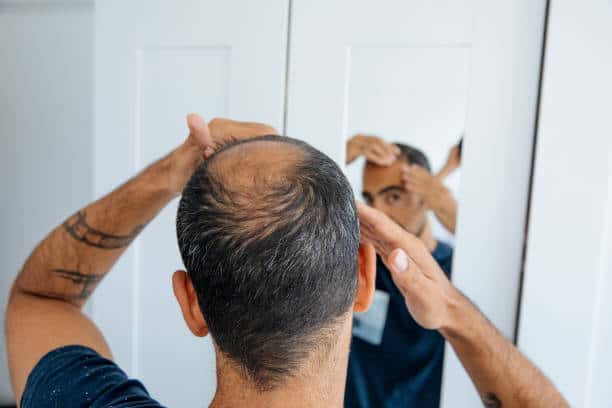
Does minoxidil work? For most men catching hair loss early, yes — but the honest version comes with conditions nobody puts on the box. Roughly a third to 40% of men see meaningful regrowth, another chunk hold onto what they have, and a minority get very little. Whether you land in the first group depends less on luck than on how, where, and how long you use it.
Minoxidil is one of only two hair-loss treatments the FDA has actually approved for men. It’s cheap, sold over the counter, and it has decades of data behind it. It’s also widely misunderstood, which is why so many men quit right before it would have started paying off.
How Minoxidil Actually Works on the Scalp
Here’s a fact that surprises people: minoxidil started life as a blood-pressure pill. Patients taking it grew hair in unexpected places, and a topical version for the scalp followed. It’s a vasodilator, so it widens blood vessels and improves circulation to the follicle, but that’s only part of the story. It also shortens the resting phase of the hair cycle and pushes follicles back into an active growth phase, thickening strands that had started to miniaturize.
That mechanism has nothing to do with hormones — which is the key difference from the other approved option. It doesn’t touch testosterone or DHT at all. If you want the hormonal side of hair loss, that’s covered in our piece on how finasteride and testosterone interact. Minoxidil works on the follicle directly, from the outside in.
Does Minoxidil Work for Receding Hairlines?
This is where expectations need a reality check. Minoxidil performs best on the crown and the vertex — the top and back of the scalp — where the follicles are still alive but shrinking. On a receding frontal hairline, results are far more modest, because once follicles at the temples are fully dormant there’s little left to revive.
The strength matters too. In head-to-head studies, 5% minoxidil outperformed the 2% version in men, which is why the higher concentration is the standard recommendation. Applied twice daily to a dry scalp, it gives follicles the most consistent exposure. Skipping applications is the single most common reason men conclude it “didn’t work” when the truth is it was never given a fair run.
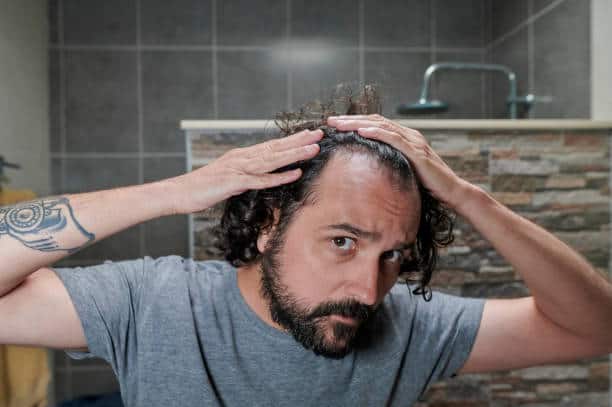
Does Minoxidil Work Faster With Other Treatments?
Often, yes. Minoxidil and finasteride attack the problem from opposite directions — one stimulates the follicle, the other blocks the DHT that’s shrinking it — so men frequently combine them for a better result than either alone. A network meta-analysis of hair-loss treatments found the combination tends to beat monotherapy for overall density.
Oral minoxidil has also moved into the picture. A recent randomized trial comparing oral and topical minoxidil found low-dose daily tablets produced comparable — in some measures better — regrowth than the lotion, without the greasy scalp. It’s prescription-only and needs monitoring for blood-pressure and fluid effects, so it isn’t a DIY swap. That’s a decision for a clinician, ideally one who’s also looked at whether other factors are dragging your hair down.
How Long Before Minoxidil Works?
Patience is the price of admission. Most men see nothing for the first two to three months, and many go through an early shedding phase that feels like the opposite of progress — old hairs falling out as new ones push through. Visible improvement usually shows up around months four to six, with the fuller picture at a year.
And it’s not a cure. Stop applying it and the regrown hair gradually reverts over the following months, because the underlying process resumes. Minoxidil manages hair loss; it doesn’t end it. Men who understand that going in stick with it. Men who expect a permanent fix in eight weeks tend to give up and waste the money they already spent.
When Minoxidil Doesn’t Work
Sometimes the scalp isn’t the problem. Hair thinning can be driven by thyroid issues, iron deficiency, stress, medication, or a hormonal picture that a topical simply can’t reach. If your energy, libido, and mood have slipped alongside your hairline, it’s worth reviewing the signs of low testosterone in men and getting proper bloodwork before you blame the minoxidil.
There’s also overlap worth understanding for men on hormone therapy. Raising testosterone can nudge DHT up and accelerate genetic hair loss, which is why some men on testosterone replacement therapy pair it with hair treatment from the start. If you’ve wondered whether your therapy is a factor, our explainer on whether TRT causes hair loss walks through it.
The Bottom Line on Minoxidil
Minoxidil works for a solid share of men, works best on the crown, works better with the right partners, and only works as long as you keep using it. The men who are disappointed are usually the ones who quit early, used too little, or never checked whether something else was pulling the strings. If you’re not sure which camp you’re in, that’s exactly what a proper assessment sorts out. At Boost Health Clinic we look at your scalp and your bloodwork together, then build a plan around what’s actually happening — not a one-size bottle off a shelf.
Need blood work? See our blood tests for men in Indonesia, available as blood tests in Bali and blood tests in Jakarta.
Hair loss treatment near you: hair loss treatment in Bali · hair loss treatment in Jakarta